
For professional growth and career success, passing the PRMIA 8010 Certification test is essential. This certification makes you stand out as a more competitive applicant in the job market by attesting to your abilities and expertise in a certain field. Obtaining 8010 Certification demonstrates your proficiency and commitment to keeping up with industry norms and procedures. Better employment prospects, more pay, and a more fulfilling career path can all be unlocked by this acknowledgment.
You will also study advanced subjects, including risk governance, regulatory frameworks, and the importance of professionalism and ethics in risk management.
The PRMIA-8010 exam equips you to apply risk management concepts in a variety of financial situations by emphasizing real-world scenarios and case studies. This ensures that you are prepared to make wise decisions and successfully manage risk.
Keep reading and exploring to learn how you can crack the 8010 PRMIA certification successfully in 2026.
What is PRMIA?
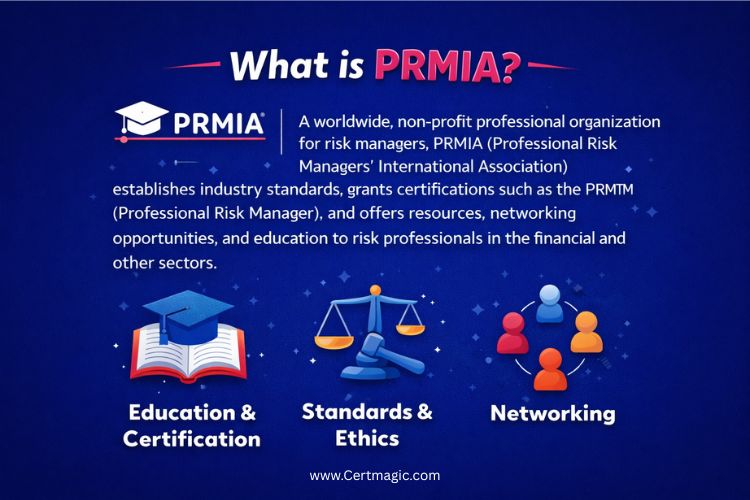
A worldwide, non-profit professional organization for risk managers, PRMIA (Professional Risk Managers’ International Association), establishes industry standards, grants certifications such as the PRMTM (Professional Risk Manager), and offers resources, networking opportunities, and education to risk professionals in the financial and other sectors. Through training, events, and peer-reviewed research, they advance competency, ethical behavior, and best practices.
Here are the Principal roles of PRMIA:
- Education & Certification: Provides alternative credentials (such as ORM) for risk management proficiency in addition to the internationally renowned PRMTM accreditation.
- Standards & Ethics: Describes and advances ethical norms and best practices in risk management.
- Networking: Establishes connections between professionals via regional chapters, events, and global networks.
- Research: Promotes peer-reviewed research and thought leadership in fields including ESG risk and climate change.
- Professional Development: Offers tools for career advancement, webinars, and online courses.
What Makes PRMIA 8010 Certification Important?
Obtaining the PRMIA 8010 Certification shows a dedication to global risk management standards in addition to technical proficiency. Analysts, risk managers, compliance specialists, and recent finance grads looking for international recognition may find it very helpful. Here are the key points where the PRMIA-8010 exam is important for students:
-
A Solid Foundation In The Principles Of Risk Management
Fundamental concepts, including probability theory, statistics, financial products, and quantitative risk assessment, are the main topics of the PRMIA 8010 test. Understanding market, credit, and operational risks in actual financial settings requires this foundation.
-
Worldwide Accreditation
The 8010 test is particularly helpful for people looking for international employment prospects because PRMIA credentials are recognized internationally. It conveys trustworthiness to employers in financial institutions, banks, and asset management companies.
-
Possibilities For Career Advancement
Possessing the PRMIA 8010 Certification can lead to positions as a quantitative analyst, financial risk manager, portfolio risk expert, and risk analyst. Additionally, it raises your profile for leadership positions in risk-focused teams and promotions.
-
Compliance With Industry Requirements
The 8010 PRMIA certification closely complies with both statutory requirements and contemporary risk management techniques. In a subject that is always changing as a result of market shifts and regulatory changes, this guarantees that qualified experts remain relevant.
-
The Route To Further PRM Certifications
The first stage in earning the whole PRM designation is PRMIA 8010. Candidates can gradually develop profound experience in professional risk management by passing this test, which lays the foundation for higher-level PRM examinations.
Opportunities for Employment Following PRMIA 8010 Certification
-
Manager of Risk
- Oversee and manage an organization’s risk assessment and mitigation plans.
- Create and put into effect risk management guidelines and practices.
-
Consultant for Risk
- Give firms advice on risk management tactics and best practices.
- Provide clients with specialized risk management solutions.
-
Officer of Compliance
- Make sure the company abides by internal policies and legal obligations.
- Keep an eye on compliance concerns, report them, and take corrective action.
-
Internal Auditor
- To evaluate the efficiency of risk management, control, and governance procedures, conduct internal audits.
Key Topics Covered in the PRMIA-8010 Exam
Before you prepare for the 8010 exam, it is necessary to read and review all the topics that are officially included in the exam. Moreover, it has become necessary to prepare according to the topics if you want to pass the exam successfully. So, here are the key topics that are covered in the PRMIA-8010 exam:
- Topic 1: Classic Credit Products: Traditional lending tools used by banks and other financial organizations, such as bonds and loans, are covered in this portion of the test.
- Topic 2: Classic Credit Life Cycle: From origination to maturity or default, this section describes the phases that a credit product goes through.
- Topic 3: Classic Credit Risk Methodology: This part discusses traditional methods for determining and measuring the risk of borrower default.
- Topic 4: Securitization and Credit Derivatives Financial instruments that combine debt-based assets into marketable securities and transfer credit risk are among the subjects addressed in this section.
- Topic 5: Modern Credit Risk Modeling: This part discusses sophisticated mathematical and statistical methods for assessing and controlling credit risk.
- Topic 6: Credit Portfolio Management: This part discusses methods for maximizing a group of credit exposures’ total risk and return.
- Topic 7: Fundamentals of Counterparty Risk: This section discusses basic ideas about the possibility that a counterparty won’t carry out their end of the bargain.
- Topic 8: Risk Mitigation: This section discusses methods and resources for lowering or shifting different kinds of financial risks.
- Topic 9: Adjustment for Credit Valuation (CVA): The fair value of derivatives is adjusted in this section to consider counterparty credit risk.
- Topic 10: Aspects of CVAs Additional factors and consequences related to credit valuation adjustment are covered in this section.
- Topic 11: CVA and Counterparty Risk Management Strategies and procedures for limiting exposure to counterparty default and maximizing CVA are covered in this section.
Why Choose Us for Studying PRMIA-8010 Exam?
-
There’s nothing better than free!
Are you preparing for certification and have become overwhelmed by exam-preparation websites, books, CDs, software, and more? The business is replete with pricey, antiquated solutions that, in the end, fall short of the quality control required to get students certified. Hundreds of examinations are available for free at Troytec.
You may study and use thousands upon thousands of free questions to ace the test. Every test gives at least 50% free to everyone, and if you’re serious about being certified and need a bit more, we have Premium Access alternatives to help you succeed.
-
We have been on this path before you; therefore, we are familiar with PRMIA.
Regardless of your background, obtaining certification is a fantastic way to start your career or earn the promotion you’ve been aiming for. Because our skilled staff has been there, we are confident that the 8010 PRMIA certification will give you the push you need to be a live success story.
Professionals with experience working with your certifications write and create our manuals. And that’s important since obtaining 8010 PRMIA certification is a big plus for your résumé and skill set, but it’s not simple.
You don’t have to choose just yet because you can find all of PRMIA’s exams and certification levels at Troytec. You may browse our inventory and choose a cert that you enjoy before starting because every test prep gives at least 50% of it for free!
-
This isn’t made-up, pointless test preparation material.
Our industry experts have years of experience, and they have created PRMIA-8010 exam preparation materials that match their expertise. You won’t be taken aback by ill-prepared questions or a lack of technical expertise because these tests mimic the real-world situations you’ll face at work or on test day.
Attend the 8010 exam with the confidence that you will succeed greatly and that your future position will be fulfilling since you have acquired the necessary abilities. We make these test preparation materials as current and as close to the test as we can. Additionally, as we previously stated, a large portion of this information is free!
-
On The Phone, Hit The Books!
These days, we want to learn wherever. You may access your test preparation materials on any mobile operating system thanks to our website’s optimization, giving you more flexibility and study time.
PRMIA-8010 Exam Sample Questions & Answers
Here are the 8010 exam sample questions you must prepare before getting our premium dumps bundle:
Question 1:
After calculating the individual UoM level loss distributions from the underlying frequency and severity curves, which of the following processes is necessary to determine the overall loss distribution for a bank for operational risk?
- Use the frequency distribution to simulate the amount of losses.
- Calculate the losses’ monetary worth using the severity distribution.
- Model the dependency between the UoMs by simulating a random number from the copula
- Use aggregate distribution curves to calculate dependent losses.
- None of the preceding
- 3 and 4
- 1 and 2
- All of the above
Question 2:
Which of the following best sums up rating transition matrices that credit rating agencies publish?
- Anticipated ex-ante migration rates between credit ratings during one year
- Default probabilities for every credit rating category
- The likelihood that ratings may change for a certain group of issuers
- Observed how frequently credit ratings changed over the course of a year.
Question 3:
Which of the following formulations approximates the CDS rate on a defaultable bond?
- Hazard rate divided by (1-Recovery rate)
- Loss given default x default rate of hazard
- Loss given default x Credit spread
- Recovery rate B x Hazard rate
Question 4:
The following is an assumption about the lack of ratings momentum:
- Stability of ratings
- Invariance of time
- The Markov property
- Herstatt danger
Question 5:
Which of the following formulas best sums up credit valuation adjustment, or CVA? LGD is for Loss Given Default, ENE stands for Expected Negative Exposure, EE stands for Expected Exposure, PD stands for Probability of Default, EPE stands for Expected Positive Exposure, and PFE stands for Potential Future Exposure.
- LGD * ENE * PD
- EPE * PD * LGD
- LGD * EE * PD
- LGD * PFE * PD
Conclusion
Troytec is dedicated to assisting you in successfully earning your PRMIA 8010 certification. You will get the greatest preparation possible because their extensive Operational Risk Manager (ORM) Exam 8010 Practice Exam is intended to closely mimic the real certification exam. You may approach your PRMIA test with confidence if you use Troytec’s materials because you’ve prepped with actual PRMIA exam questions.
Additionally, Troytec provides free desktop software as a special incentive to customers who buy a combo pack. By offering a keen and user-friendly platform for getting ready for the Operational Risk Management test, this program improves your learning experience.
FAQs (Frequently Asked Questions)
What Is The PRMIA-8010 Exam?
It confirms a fundamental understanding of professional risk management concepts.
Who Should Take The PRMIA Exam?
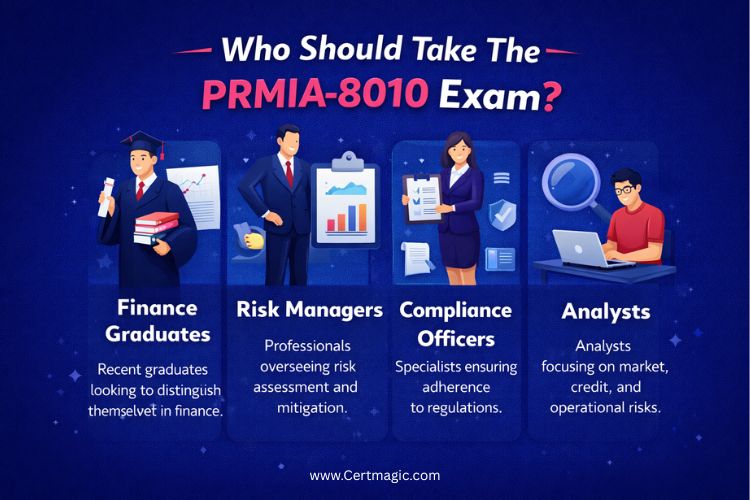
For risk and financial professionals looking for international recognition, it’s perfect.
How Can I Prepare For The PRMIA-8010 Exam?
Make use of targeted practice exams and approved PRMIA resources.
